1. The Definitive Definition
Examiner Requirement
"The electrostatic attraction between oppositely charged ions."
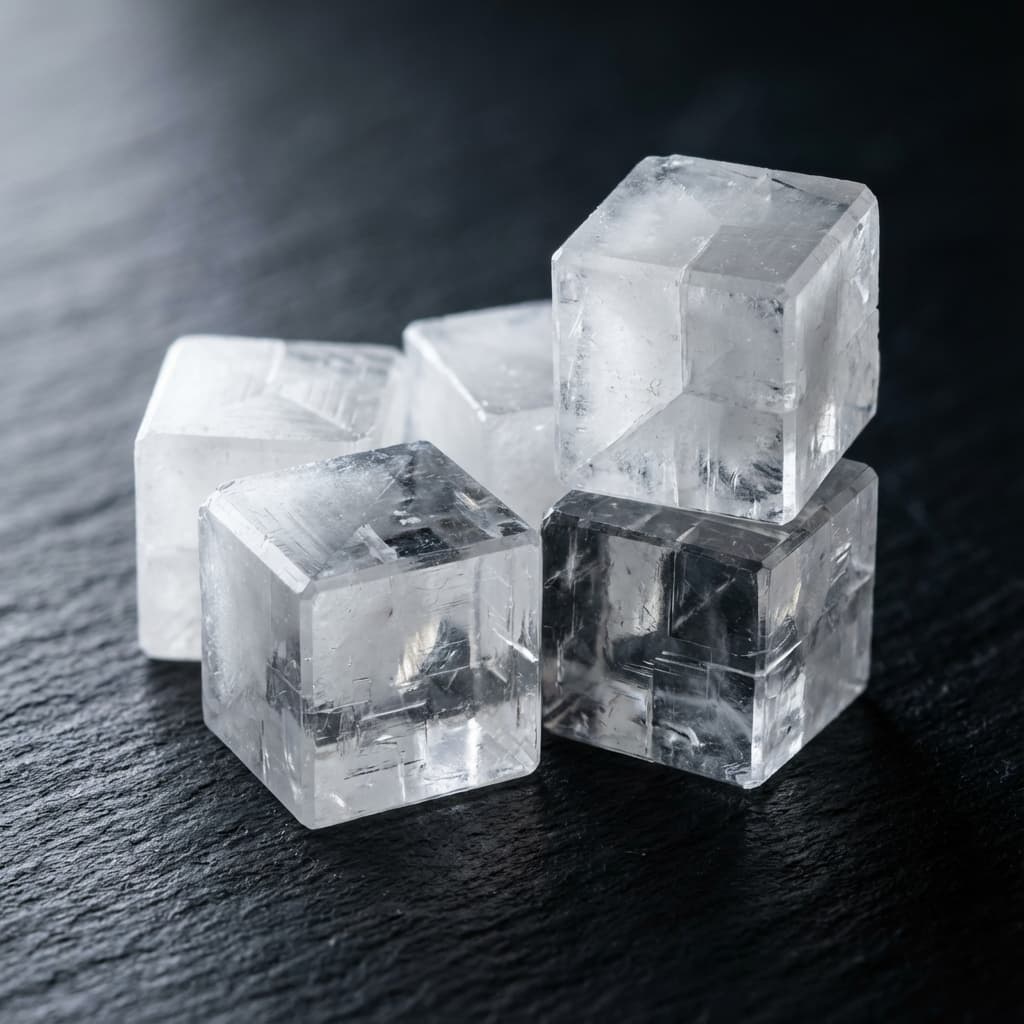
Sodium Chloride (NaCl) forms perfect cubic crystals due to its ionic lattice structure.
2. The Bonding Continuum
Bonding is rarely "100% Ionic." It exists on a spectrum governed by the Difference in Electronegativity (\(\Delta\chi\)).
Interactive: Building the Lattice
From electron transfer to massive 3D structure.
Na
Sodium Atom[2,8,1]➔
Cl
Chlorine Atom[2,8,7]Step 1: Transfer
Covalent
\(\Delta\chi < 1.8\)
Electron Sharing
→ Increasing Ionic Character →
Ionic
\(\Delta\chi > 1.8\)
Electron Transfer
⚠️ Common Pitfall: Aluminum Chloride (\(AlCl_3\))
Often assumed to be ionic (Metal + Non-metal). However, its \(\Delta\chi\) is only ≈ 1.5. It acts as a covalent molecule, subliming at low temperatures.
Reason: The high charge density of \(Al^{3+}\) polarizes the \(Cl^-\) cloud (Fajans' Rules).
3. Formula Deduction
The Cross-Over Method
Paper 2 StyleDeduce the formula for Calcium Phosphate given ions: \(Ca^{2+}\) and \(PO_4^{3-}\)
Ca²⁺Valency 2
⚔️PO₄³⁻Valency 3
1. Cross the charges to the opposite subscript:
- Ca takes the 3.
- PO₄ takes the 2.
2. Result:
\( Ca_3(PO_4)_2 \)
Student Practice Set
1.
Define the Ionic Bond.
2.
Why does AlCl₃ sublime at low temperatures?