Structure 1: Comprehensive Review
Test your understanding of Topics 1.1 - 1.5 with IB-style questions.
Paper 1A: Multiple Choice
Conditions: No Calculator. No Data Booklet. Average 1.5 mins per question.
Student Practice Set
Paper 1B: Data Analysis
Context:
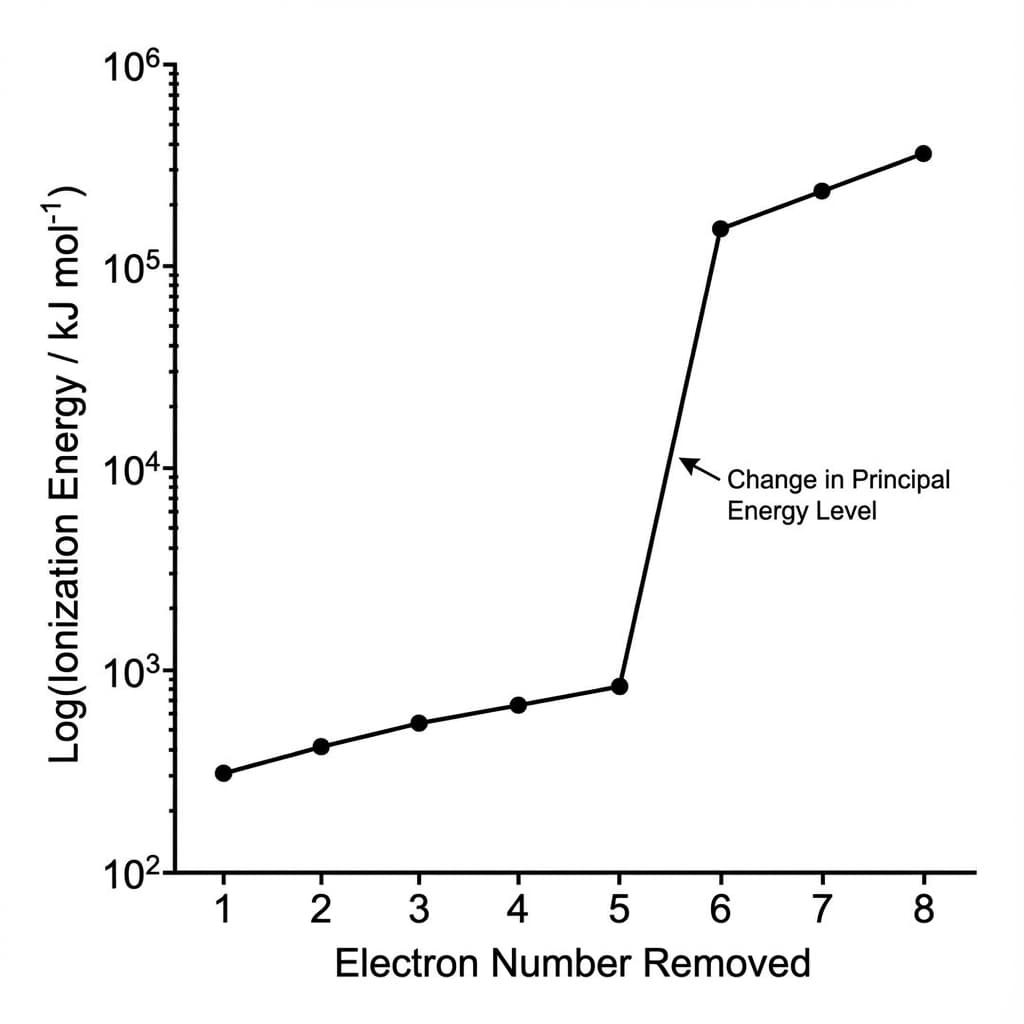
You are provided with a graph showing the Successive Ionization Energies of an unknown element X.
Analyzing Ionization Trends
The log(IE) values show a small jump between the 2nd and 3rd electron, but a massive jump between the 5th and 6th electron.
Deduce the group number of element X and explain your reasoning.
Paper 2: Extended Response
Stoichiometry & Gas Laws
Automobile airbags inflate by the rapid decomposition of sodium azide:
\( 2NaN_3(s) \rightarrow 2Na(s) + 3N_2(g) \)
Calculate the mass of \( NaN_3 \) required to inflate a 60.0 dm³ airbag to a pressure of 110 kPa at 25°C.
Emission Spectra & Convergence
The hydrogen emission spectrum consists of a series of lines requiring specific energy transitions.
- Explain why the lines in the spectrum converge at high frequency.
- State what the limit of this convergence represents.
- Calculate the energy (in J) of the transition from n=4 to n=2, given Rydberg constant \( R_H = 2.18 \times 10^{-18} \text{ J} \).