Stoichiometry uses the balanced chemical equation to determine the quantities of reactants relative to products.
Key Concepts
- Limiting Reactant: The reactant that is completely consumed. It determines the maximum product possible.
- Excess Reactant: The reactant left over after the reaction stops.
- Theoretical Yield: Maximum product calculated assuming 100% conversion.
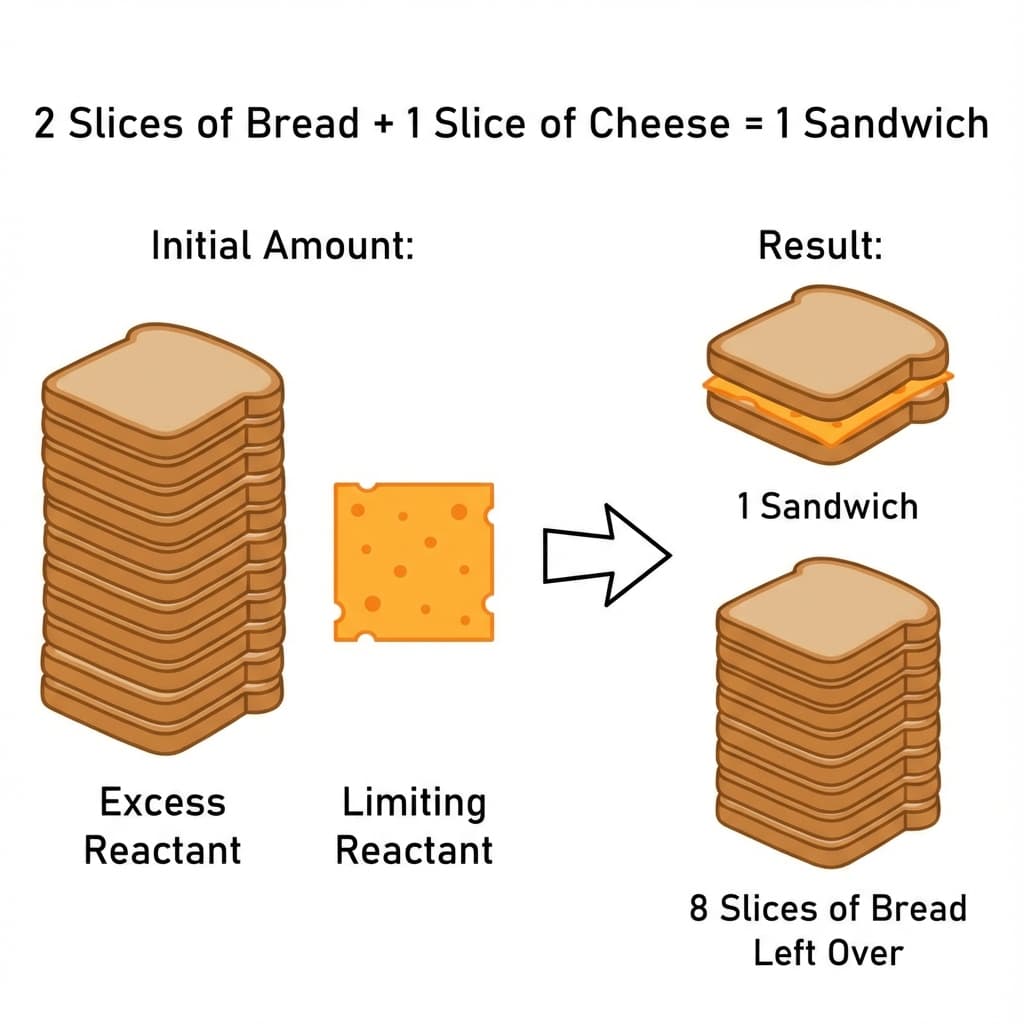
Deep Think Concept
The 'Sandwich' Analogy
Recipe: 2 Bread + 1 Cheese → 1 Sandwich
If you have 100 slices of bread but only 1 slice of cheese, you can only make 1 Sandwich. The bread is in excess. The cheese is the limiting reactant.
Chemistry is exactly the same, but we count in Moles.
Finding the Limiting Reactant
Paper 2 StyleReaction: \( N_2 + 3H_2 \to 2NH_3 \)
We mix 2.0 mol of \( N_2 \) and 3.0 mol of \( H_2 \). Which is limiting?
We mix 2.0 mol of \( N_2 \) and 3.0 mol of \( H_2 \). Which is limiting?
1. Calculate 'Mole Ratio' (Have / Coefficient):
- Nitrogen: \( \frac{2.0}{1} = 2.0 \)
- Hydrogen: \( \frac{3.0}{3} = 1.0 \)
2. Compare: The lowest number wins.
3. Conclusion: \( 1.0 < 2.0 \), so Hydrogen is the Limiting Reactant.
4. Calculate Product: Use the limiting (H₂) to find NH₃.
3 mol H₂ produces 2 mol NH₃. So 3.0 mol H₂ produces 2.0 mol NH₃.
Percentage Yield
In real life, we assume 100% yield, but accidents happen (spills, side reactions, incomplete reaction).
\( \% \text{ Yield} = \frac{\text{Experimental Mass}}{\text{Theoretical Mass}} \times 100 \)
Student Practice Set
1.
For \( 2A + B \to C \), if you have 4 mol of A and 4 mol of B, which is limiting?