IB CHEMISTRY

1.1.2

Kinetic Molecular Theory

The properties of solids, liquids, and gases can be explained by the movement and arrangement of particles.

Comparing the States
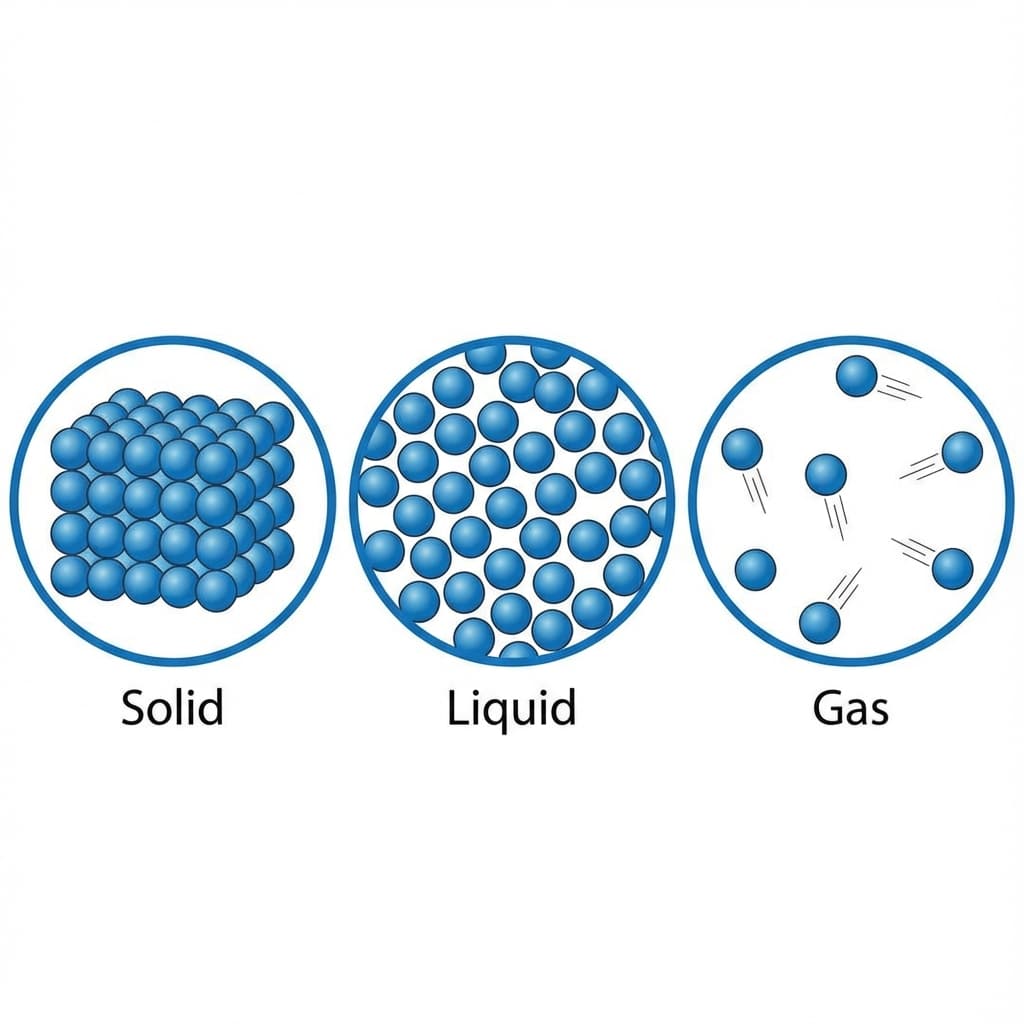
Particle arrangement: Solid (Lattice), Liquid (Random), Gas (Far apart)
FeatureSolid (\(s\))Liquid (\(l\))Gas (\(g\))
ArrangementFixed lattice. Regular.Random. Close together.Random. Far apart.
MotionVibrate only.Slide past each other.Rapid random motion.

Changes of State

Terminology is key.

Solid → Liquid:
Melting
Liquid → Solid:
Freezing
Liquid → Gas:
Vaporization
Gas → Liquid:
Condensation
Solid → Gas:
Sublimation
Gas → Solid:
Deposition
Deep Think Concept

Why does the temperature of boiling water stay flat?

This phenomenon highlights the distinction between Kinetic and Potential energy.

  • Definition: Temperature is a measure of average Kinetic Energy (speed of particles).
  • The Mechanism: During a phase change (boiling), the added heat energy is not used to speed up the particles. Instead, it performs work to overcome intermolecular forces, increasing the distance between particles.
  • Conclusion: This energy is stored as Potential Energy. Since the speed doesn't change, the thermometer reading flatlines.

Worked Example: Cooling Curve Logic

Paper 2 Style
A student records the cooling curve of a pure substance X. The graph shows a temperature drop, a horizontal plateau at \(55^\circ C\), and then a further drop. Explain the change in particle arrangement at \(55^\circ C\).

Student Practice Set

1.
Which transition represents sublimation?